Rupal Kalebere
The Army’s Tech Pivot
The Ministry of Defence’s Technology Perspective and Capability Roadmap (TPCR) 2025 is a bold 15-year vision for India’s armed forces. For the Army, it marks a paradigm shift away from the legacy model of massed manpower and steel, and towards precision, autonomy, and networked lethality.
This change is driven by both experience and threat perception. The Ladakh standoff highlighted the limitations of heavy armour at altitude, while conflicts in Ukraine and the Caucasus have revealed how drones and smart munitions can overwhelm traditional forces. Meanwhile, China’s deployment of hypersonic systems, AI-enabled ISR, and spectrum warfare assets has sharpened India’s need to leap forward technologically.
In response, TPCR 2025 places the Army’s focus on hypersonic strike systems, next-generation armour, unmanned platforms, smart munitions, and AI-enabled networks. Together, these priorities illustrate how India’s land forces are preparing for wars where speed, connectivity, and survivability matter as much as raw firepower.
Hypersonics as the Spearhead of Precision Warfare
TPCR 2025 lists requirements for tens of thousands of fourth and fifth-generation ATGMs, supported by long-range precision systems. These are designed for top-attack, fire-and-forget, and fire-and-observe roles, with tandem HEAT warheads capable of penetrating 800 mm RHA beyond ERA. With ranges beyond five kilometres and hit probabilities over 90 percent, these weapons reflect an ambition to push into hypersonic territory, where speed compresses reaction times and reshapes the escalation ladder.
India’s own hypersonic research, led by DRDO’s scramjet demonstrators and glide vehicle programmes, positions the Army to eventually field systems that can outpace adversary defences. Strategically, such capabilities provide a conventional deterrent against China and Pakistan, signalling that India can hold high-value targets at risk without escalating to nuclear thresholds.
Tech Snapshot: Hypersonics & Missiles
| Requirement | Specifications | Scale |
| ATGMs (4th/5th Gen) | Range >5 km; min launch 200 m; 90% hit probability; active/passive seekers; multiple modes (fire-and-forget, top-attack, fire-and-observe) | 20,000–50,000 units |
| Warhead | Tandem HEAT, penetration >800 mm RHA beyond ERA | Army-wide induction |
| Tech Leap | Scramjet propulsion R&D; hypersonic testbeds | Conventional deterrence vs China/Pakistan |
Reimagining Armour for the 21st Century
Tanks remain central to land warfare, but TPCR 2025 redefines them for the digital battlefield. The Future Ready Combat Vehicle (FRCV), with 1,700–1,800 units planned, will be less a traditional tank and more a command node on tracks. It will integrate UAV control, AI-driven ISR, beyond-line-of-sight strike with loitering munitions, and cyber/EW hardening.
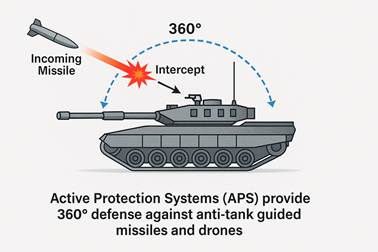
At the same time, the Army recognises the need for agility. Plans for 300–400 light tanks tailored for Ladakh-type terrain show lessons learned from 2020, where heavy armour was logistically constrained. Meanwhile, the T-90 fleet will not be left behind. With upgrades including Active Protection Systems, more powerful engines, and improved ordnance, these platforms will remain relevant until the FRCV arrives.
Tech Snapshot: Armour
| Platform | Specifications | Quantity | Tech Leap |
| Future Ready Combat Vehicle (FRCV) | AI integration, 360° ISR vision, UAV/UGV teaming, BLOS strike, EW hardened | 1,700–1,800 units | Networked combat hub |
| Light Tanks | High-altitude mobility, EW & counter-drone capability | 300–400 units | Suited for Ladakh terrain |
| T-90 Upgrades | APS with 360° protection; 1350 HP engines; improved ordnance with >1000 mm penetration | APS: 800+; Engines: 450–500; Ordnance: 1,500–1,700 | Survivability and lethality boost |
The Rise of UAVs and Loitering Munitions
If tanks symbolised 20th-century land power, drones symbolise the 21st. TPCR 2025 makes them a central pillar of the Army’s force structure. Requirements include stealth RPAs for deep ISR, integrated targeting systems for real-time fire control, UAV-launched precision munitions, and large numbers of loitering drones. Tethered drones at formation level will provide persistent overwatch and secure data relays.
This ecosystem means brigades will no longer wait for satellite passes or Air Force sorties. They will have their own organic ISR and strike capability, collapsing the decision loop from detection to destruction.
Tech Snapshot: UAVs & ISR
| System | Specifications | Quantity | Role |
| Stealth RPAs | Low radar cross-section, long endurance | 55–70 units | Deep ISR in contested zones |
| Integrated Surveillance & Targeting Systems (ISAT-S) | Combines UAVs + loitering munitions; EO/IR sensors, secure comms, AI target recognition | 700–800 units | Real-time ISR + precision targeting |
| UAV-launched PGMs (ULPGMs) | Precision-guided missiles launched from drones | 350–400 units | Expands drones into strike role |
| Tethered Drones | Cable-powered, persistent aerial surveillance | Formation-level | Continuous overwatch & secure relay |
Smart Munitions and the Future of Artillery
Massed firepower is giving way to precision dominance. The Army’s requirement for over 600,000 extended-range 155 mm shells illustrates the scale of investment in long-range firepower, reaching up to 70 km. With GPS/INS-guided fuzes, these shells can adjust trajectory mid-flight, reducing the need for saturation barrages.
Other priorities from next-gen APFSDS tank rounds to programmable 23 mm and 30 mm proximity ammunition underscore a focus on counter-drone warfare and survivability in the air-land domain. Advanced flares and chaffs will further protect platforms from precision strikes.
Tech Snapshot: Smart Munitions
| Type | Specifications | Quantity | Purpose |
| 155 mm Extended Range Shells | Range 60–70 km | 600,000+ rounds | Deep fire support |
| GPS/INS Fuzes | Course-correcting, trajectory adjustment | Thousands | Precision accuracy |
| 125 mm APFSDS | Penetration >1000 mm | Large-scale | Defeat advanced armour |
| 30 mm Proximity Ammo | Programmable, anti-drone | Thousands | Counter-UAV warfare |
| 23 mm Smart Ammo | Programmable | Thousands | Short-range air defence |
| Flares & Chaffs | Multispectral decoys | Thousands | Platform survivability |
AI, Networks and Spectrum Warfare
Underlying all of this is the Army’s quest for information dominance. TPCR 2025 emphasises large-scale induction of Software Defined Radios, AI-enabled decision systems, and spectrum denial tools. Mechanised units will share real-time maps and feeds; AI “as a Service” will support thousands of users; and EW systems will blind enemy UAVs or disrupt drone swarms.
This reflects a doctrinal leap: networks are no longer just support systems, but weapons in their own right. In a future conflict, the side that controls data flows and spectrum access will likely prevail, even before tanks clash or artillery fires.
Tech Snapshot: AI, EW & Networks
| System | Specifications | Scale | Tech Leap |
| Software Defined Radios | Secure comms, multi-band capability | 60,000+ units | Spectrum resilience |
| Situational Awareness Systems | AI-enhanced digital mapping | 3,500–4,000 platforms | Enhanced battlefield awareness |
| AI as a Service | Cloud-based AI decision support | 4,000 users | Faster command cycles |
| EW Tools | Electronic denial bubbles, anti-swarm jammers | Army-wide | Spectrum dominance |
Conclusion: Towards a Smarter Army
TPCR 2025 paints a picture of an Army that is smaller in numbers but bigger in intelligence. Its focus is not on outproducing adversaries in tanks or artillery, but on outthinking them through precision, speed, and autonomy.
For industry, the roadmap signals where to invest: hypersonic propulsion, AI algorithms, drone payloads, smart munitions, and spectrum warfare tools. For the Army, it is a path towards building formations that are as connected and resilient as they are lethal.
By 2035, India’s land forces will not just fight with tanks and guns. They will fight with drones, algorithms, and networks in an ecosystem where firepower and information power converge. The future battlefield will be shaped less by brute force and more by connectivity, autonomy, and precision.