A Month of Strategic Signalling, Maritime Outreach, and Defence Industrial Deepening
Rupal Kalebere
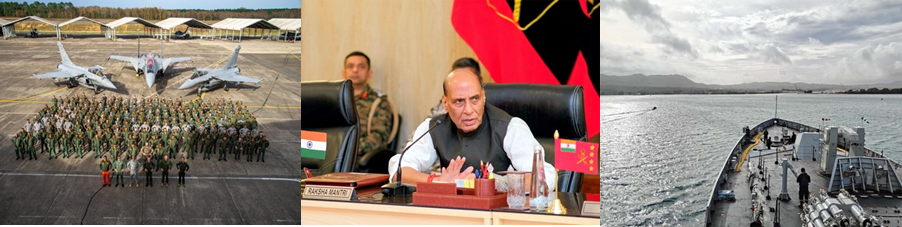
2025 marked one of the most dense and strategically consequential months in India’s recent defence diplomacy. Spanning 23 distinct international engagements, India demonstrated a calibrated blend of normative leadership, maritime security provision, military interoperability, and defence-industrial consolidation, firmly positioning itself as a net security provider and preferred partner across the Indo-Pacific and beyond.
1. Indo-Pacific Normative Leadership & ASEAN-Centric Diplomacy
India’s engagement with ASEAN formed the political and strategic backbone of the month. At Kuala Lumpur, Rajnath Singh participated in both the India–ASEAN Defence Ministers’ Informal Meeting and the 12th ADMM-Plus, where ASEAN Defence Ministers explicitly hailed India as a responsible stabilising power in the Indo-Pacific.
Key strategic messages included:
- Rule of Law & UNCLOS: India clarified that its emphasis on freedom of navigation and overflight is not directed against any country, but aimed at safeguarding collective regional interests.
- Inclusivity & Sustainability: India aligned its outlook with ASEAN’s emphasis on inclusive security architectures resilient to emerging shocks.
- MAHASAGAR Vision: India reiterated its commitment to Mutual and Holistic Advancement for Security and Growth Across Regions as the guiding framework for regional cooperation.
India also announced two forward-looking initiatives:
- ASEAN–India Initiative on Women in UN Peacekeeping Operations
- ASEAN–India Defence Think-Tank Interaction
These engagements reinforced ASEAN centrality while embedding India firmly into the region’s security architecture.
2. Maritime Diplomacy & Net Security Provision in the Indian Ocean
India’s naval deployments in November 2025 underscored its role as a First Responder and Preferred Security Partner in the Indian Ocean Region (IOR).
INS Savitri – Multi-Country Maritime Outreach
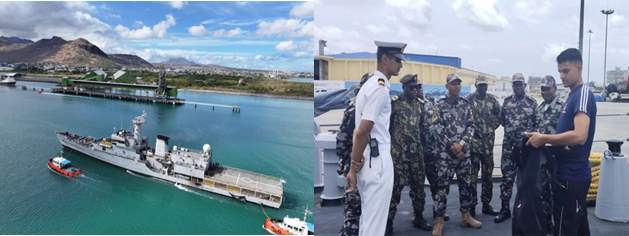
The Offshore Patrol Vessel INS Savitri undertook an extended operational deployment covering:
- Mauritius – joint EEZ surveillance with the National Coast Guard
- Mozambique (Beira) – VBSS drills, damage control, firefighting exercises, and medical outreach
- Seychelles – spares handover, joint EEZ surveillance, and capacity-building activities
These engagements combined hard security tasks (surveillance, VBSS) with soft-power outreach (medical camps, community interaction), reflecting India’s integrated maritime approach.
Western Pacific & Southeast Asia
- INS Sahyadri participated in Exercise MALABAR-2025 at Guam, followed by a port call at Manila, conducting VBSS, tactical manoeuvres, and flying operations with the Philippine Navy.
- Indian Naval LCUs 51, 54 & 57 from the Andaman & Nicobar Command visited Colombo, reinforcing interoperability with the Sri Lanka Navy.
Together, these deployments signalled India’s persistent maritime presence from the western Indian Ocean to the western Pacific.
3. High-Intensity Military Exercises & Interoperability
November 2025 saw India participate in multiple land, air, and naval exercises, sharpening interoperability across diverse theatres:
- Exercise MALABAR-2025 (Guam) – advanced ASW, joint fleet operations
- Exercise GARUDA-25 (France) – IAF Su-30MKI with French Rafale/Mirage forces in complex air combat
- Exercise MITRA SHAKTI XI (Sri Lanka) – UN Chapter VII sub-conventional operations with drones & C-UAS
- Exercise AJEYA WARRIOR-25 (UK) – counter-terrorism in semi-urban environments
- Exercise SURYAKIRAN XIX (Nepal) – mountain CT, HADR, UAS, AI-enabled decision tools
These exercises collectively highlighted India’s transition towards technology-enabled joint operations while reinforcing UN-mandated peacekeeping competencies.
4. Defence Industry, R&D, and Technology Partnerships
A defining feature of November 2025 was the convergence of diplomacy and defence industrial policy.
Strategic MoUs & Agreements
- India–Israel JWG (Tel Aviv): MoU covering AI, cyber security, advanced technologies, and co-development.
- DRDO–DGA France Technical Agreement: Cooperation in AI, cyber, space, quantum, underwater technologies, advanced propulsion, and materials.
- India–Vietnam DPD: MoU on Mutual Submarine Search & Rescue and LoI on defence industry cooperation.
- India–Germany High Defence Committee: Focus on co-development, co-production, and niche technologies.
- India–Oman JMCC: Joint development, technology sharing, and expanded production partnerships.
Big-Ticket Sustainment Deal
- MoD–US LOAs worth ~₹7,995 crore for five-year sustainment of MH-60R helicopters, including in-country MRO and intermediate-level repair facilities—directly advancing Aatmanirbhar Bharat objectives.
5. India–Indonesia: A Maritime Strategic Axis
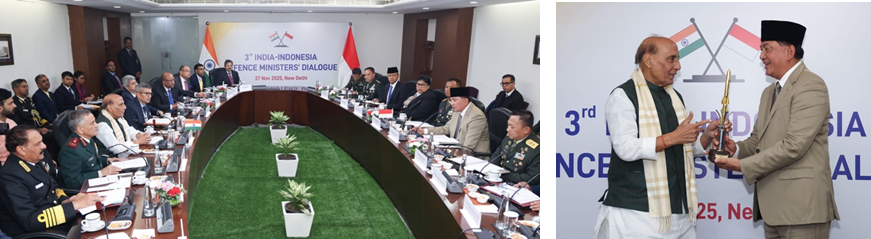
The 3rd India–Indonesia Defence Ministers’ Dialogue in New Delhi emerged as a strategic centrepiece of the month.
Key outcomes:
- Shared commitment to a free, open, peaceful Indo-Pacific
- Proposal for a Joint Defence Industry Cooperation Committee
- Enhanced cooperation in maritime domain awareness, cyber resilience, and submarine capability
- Coordination within ASEAN-led mechanisms and the Indian Ocean Rim Association
- Collaboration in defence medicine and humanitarian assistance
The dialogue reflected India and Indonesia’s evolving role as maritime anchors of the eastern Indian Ocean.
6. India–US Maritime Convergence
The visit of Dinesh K. Tripathi, Chief of the Naval Staff, to the United States and its detailed follow-up highlighted the operational depth of India-US naval ties:
- Focus on MDA, undersea infrastructure security, unmanned systems, ISR, cyber, and space
- Refinement of MALABAR, PASSEX, CMF, and MILAN
- Expanded cooperation in HADR and professional military education
Conclusion: November 2025 as a Strategic Inflection Point
November 2025 showcased India operating simultaneously as:
- a norm-shaper in Indo-Pacific security,
- a maritime first responder across the IOR,
- a trusted military partner in high-end exercises,
- and a credible defence-industrial collaborator.
The sheer breadth of engagements across diplomacy, deployments, exercises, and industry underscores India’s transition from a regional security consumer to a system-shaping defence power, with MAHASAGAR, Act East, and Aatmanirbhar Bharat forming the strategic triad guiding its international defence posture.