Vice Admiral Puneet Kumar Bahl, AVSM, VSM (Retd)
Shipbuilding and Recycling. India is also making strategic moves to bolster its presence in shipbuilding and recycling with an aim to add 1,000 ships by 2047 via a new shipping company to be co-owned by the Government, PSUs and foreign players[1]. Domestic demand channelization for shipbuilding and development of common platforms for ancillary and marine design ecosystems are being actively looked at, along with promoting waste to wealth initiatives through increased scrap usage in the Steel industry. Five Shipbuilding and Repair Clusters are planned in coastal states with generous financial and regulatory incentives. Foreign collaboration (notably with Japan and South Korea) is being explored for technology and capacity enhancement. Globally, India ranks 2nd in ship recycling (33 per cent share). Efforts are on to improve global ranking to 1 by 2030[2].
Inland Waterways Augmentation and Growth. Another area receiving aggressive attention is the development of inland waterways and coastal shipping to reduce dependency on road and rail transport from their levels of 66 % and 31% respectively, thereby lowering logistics costs, traffic congestion and pollution. Over 5,000 km of navigable waterways is under development. There are plans to operationalize six new National Waterways and 26 more have been identified. Jal Marg Vikas Project by Inland Waterways Authority of India (IWAI) with assitance fm World Bank includes key projects on Ganga, Brahmaputra and Mahanadi rivers. Ro-Ro and ferry services for passengers & cargo are also being expanded[3]. India has increased the modal share of cargo by Inland Waterways (IW) from 0.5 per cent to 2 per cent and has had a 19 per cent year-on-year growth in cargo volumes over the last 5 years. Aim is to enhance Inland water transport use to 5 per cent by 2030[4]. As a part of digital solutions, CAR-D(Cargo Data) web based Portal is in use for collection, compilation, analysis and for public viewing of IW cargo and passenger data. By 2035, India’s coastal shipping modal share is also expected to grow from 6 to 33 per cent, reflecting the robust potential for economic expansion[5].
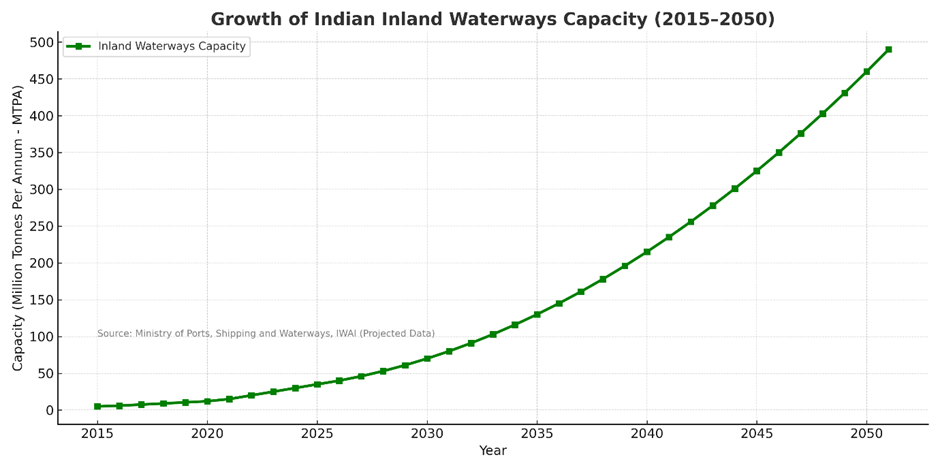
Figure 1: Growth of Inland Waterways
Figure 1 shows the growth of Indian Inland Waterways capacity from 2015 to 2050 (generated from figures of Ministry of Ports Shipping & Waterways)
Promoting Ocean, IW and Coastal Cruise Sector. Cruise Bharat Mission (CBM), launched in September 2024, aims to position India as a cruise tourism hub. It facilitates policy, interagency and inter-ministry coordination. Development and operationalisation of ferry & Cruise Terminals on IWs is an imperative. Consequently, international cruise terminals are planned to be increased from 3 to 10 and river cruise terminals from 50 to 100 by 2029. Various Cruise training academies have opened in different locations in India including on the private side. CBM aims to double sea cruise passenger traffic in the country to 10 lakh and also to increase river cruise passenger traffic by more than 10 times to 50 lakhs by 2047[6].
International Maritime Cooperation Initiatives. India is also deepening international maritime cooperation through the MAHASAGAR framework, building on the SAGAR vision. Connectivity grids with neighboring nations are also being developed for cargo, ferry, and cruise routes. India has also launched the Indian International Maritime Dispute Resolution Centre (IIMDRC) under the “Resolve in India” initiative[7]. Further, India is actively engaging in forums like Indo Pacific Ocean Initiative (IPOI), Indian Ocean Rim Association(IORA), Indo Pacific Economic Framework for Prosperity (IPEF), Quad, and Information Fusion Centre-Indian Ocean Region (IFC-IOR).
Green Shipping Initiatives. Another area of sustained focus by India is in the transition to green shipping through Harit Sagar Green Port Guidelines. Five Green Hydrogen/Ammonia hubs and more than 1000 Green Vessels are planned by 2029. The Green Tug Transition Program (GTTP) targets full transition of tugs to clean energy by 2040, and Harit Nauka Guidelines aim for 100 percent green fuels in inland vessels by 2045[8].
Training and Skilling. India is also committed to developing a world-class and very well-trained maritime workforce. Ranked among top 5 global manpower suppliers; seafarer numbers rose from 1.16 lakh in 2016 to 2.85 lakh in 2024, with 85% serving on foreign-flagged ships. The goal is to contribute to 20 per cent global workforce share[9].
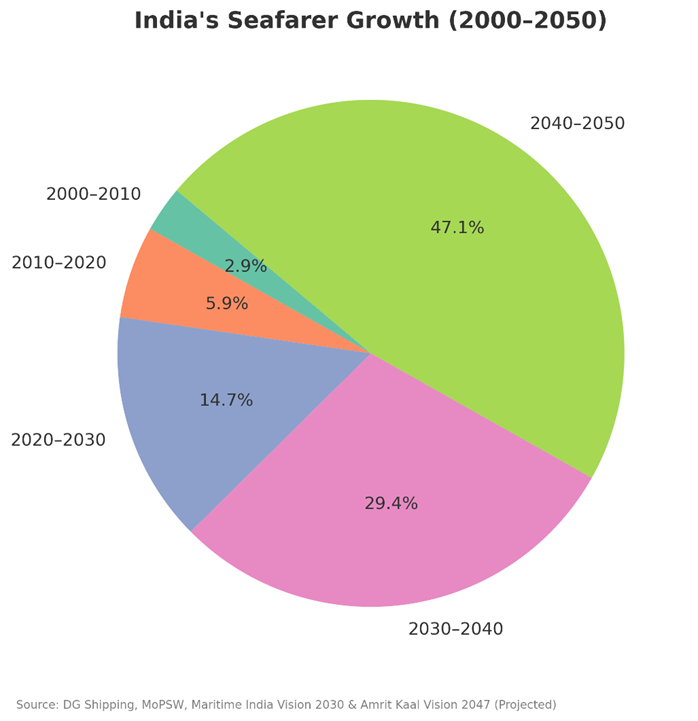
Figure 2 illustrates the significant projected growth in India’s seafarer population, particularly driven by the MAKV 2047 (Generated from figures of MIV 2030 and MAKV 2047 by the Ministry of Port Shipping & Waterways)
[1] Reuters, “India plans new shipping firm to expand fleet by 1,000 ships in next decade”, Business Standard, 06 January 2024. https://www.business-standard.com/industry/news/india-plans-new-shipping-firm-to-expand-fleet
[2] Ministry of Ports, Shipping and Waterways, “Maritime India Vision 2030 Document”, Chapter 5, Page 147, 22 February 2021
[3] Ministry of Ports, Shipping and Waterways, “Maritime India Vision 2030 Document”, Chapter 6, Page 167, 22 February 2021
[4] Ministry of Ports, Shipping and Waterways, “India’s Record Cargo Movement on Inland Waterways Achieves 145.5 million tonnes in FY 2024–25”, PIB press release 24 April 2025, https://pib.gov.in/PressReleaseIframePage.aspx?PRID=2124061
[5] Ashish Kumar Chauhan, “Indian blue economy is thriving but country needs to be careful about marine litter”, Down to Earth, 20 February 2023. https://www.downtoearth.org.in/environment/indian-blue-economy-is-thriving
[6] Ministry of Ports, Shipping and Waterways, “Cruise Tourism in India: A Voyage of New Possibilities” PIB press release 21 April 2025. https://pib.gov.in/PressReleasePage.aspx?PRID=2123171
[7] International Institute of Marine Surveying, “India launches its own centre for maritime arbitration”, 17 September 2024. https://www.iimsuae.org/local-news/india-launches-its-own-centre-for-maritime-arbitration/
[8] Ministry of Ports, Shipping and Waterways, “Maritime Amrit Kaal Vision 2047”, PIB press release 03 December 2024, https://pib.gov.in/PressReleaseIframePage.aspx?PRID=2080010
[9] Ministry of Ports, Shipping and Waterways, “Maritime India Vision 2030 Document”, Chapter 10, Page 247, 22 February 2021